Loom beading vs peyote stitch is a question almost every beginner asks when they first fall in love with tiny seed beads. Both techniques look beautiful in photos and promise gorgeous bracelets, but choosing where to start can feel confusing.
Should you invest in a loom, or just grab some beads and start stitching? Let’s walk through the differences calmly, like a friendly chat at the bead shop counter, so you can choose the technique that really suits you.
1. What Is Loom Beading?
Loom beading is exactly what it sounds like: you work on a small beading loom that holds your threads under tension, while you add rows of beads across them. The loom acts a bit like a tiny weaving frame, keeping everything straight and organised.
To get started you usually need a loom, beading needle, thread and seed beads. Most beginners use size 10/0 or 11/0 beads and a simple nylon beading thread. Once the warp threads are set up, you slide a row of beads onto your needle, push them under the warps, and sew back through to lock them in place. Row after row, a bracelet or strip of beadwork appears.
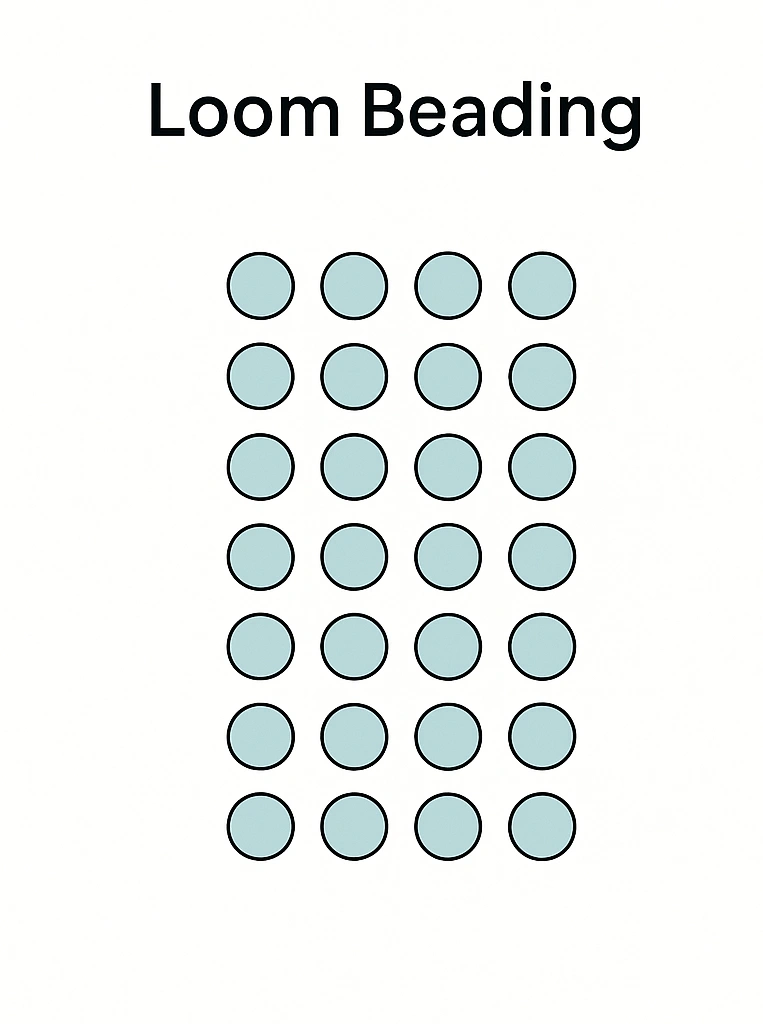
Many people love loom beading because it feels structured and predictable. The design sits on a grid, very similar to cross-stitch or pixel art. If you enjoy counting squares and watching a pattern emerge line by line, a loom can feel very satisfying and reassuring.
The only part that tends to surprise beginners is the finishing. At the ends of your beadwork you have multiple warp threads to secure and hide. It’s not difficult, but it’s one extra step to learn on top of the basic stitching.
2. What Is Peyote Stitch?
Peyote stitch is an off-loom beadweaving technique. There is no frame, no warp threads – just you, a needle, thread and beads. The beads sit in a staggered pattern, a little like bricks in a wall, which gives peyote its distinctive texture.
To start, you pick up a first row of beads, then in the second row you “skip” every other bead, stepping up and down as you go. On paper this sounds mysterious, but in your hands it quickly turns into a calm, repetitive rhythm: pick up a bead, pass through the next “high” bead, pull the thread, repeat.
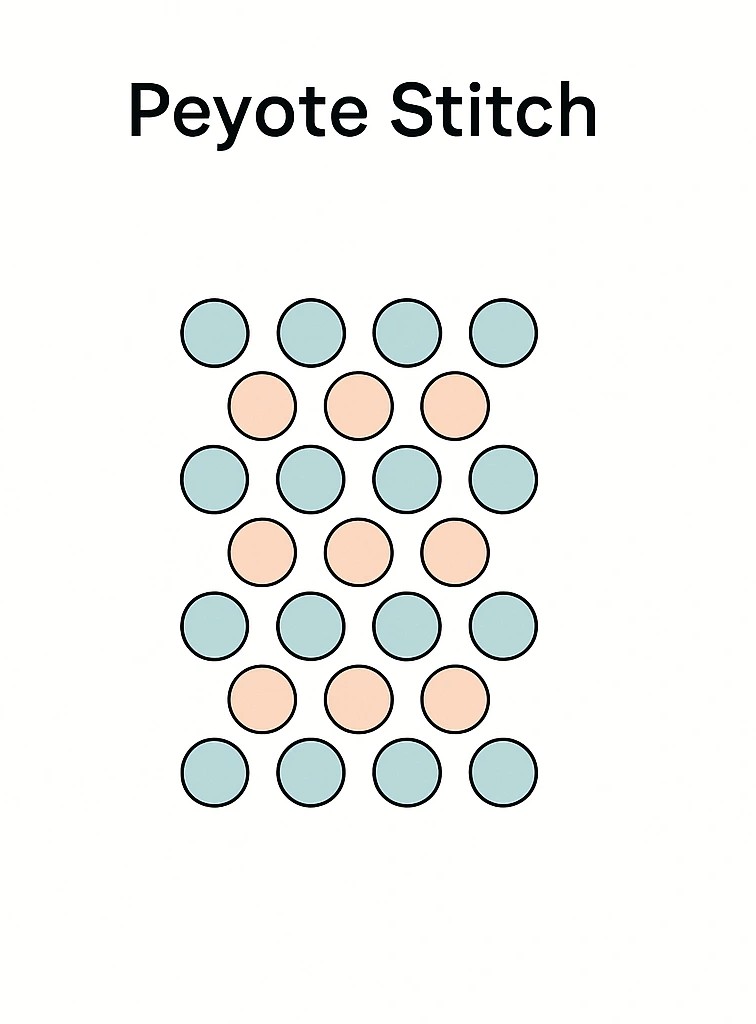
Most beginners start with even-count flat peyote. It has a simple turn at the end of each row and works beautifully for neat bracelet bands or ring bands. You don’t need special tools, and the project can live in a small tray or pouch on your desk or in your bag.
The trickiest moment is usually the first three or four rows. Until the structure appears, it can feel like the beads are flopping around and the thread has its own opinion. Once the pattern settles, though, peyote becomes very intuitive and almost meditative.
3. Loom vs Peyote Stitch: Key Differences for Beginners
Both techniques can absolutely work for a beginner. The question is what kind of learning experience you want.
1. Learning curve
With a loom, the logic is clear from the start: rows of beads, straight grid, visible pattern. Many beginners feel confident right away because they can literally see where each new row should go. The challenge often appears later, when it’s time to deal with all those warp threads.
With peyote stitch, the beginning is the confusing part. The first rows feel a bit like a puzzle, and you may need to unpick a few times. But there are fewer technical steps overall: once you understand the “up and down” motion and how to turn at the end of the row, you can reuse that same skill for many different projects.
2. Speed of progress
On a loom you add a whole row of beads at once, so wide bracelets or bookmarks grow quickly. It’s rewarding if you’re impatient to see a finished piece.
Peyote usually moves a little slower, especially when you’re new. You’re working bead by bead or in small groups. The trade-off is that the process itself is very relaxing; it’s easy to lose track of time in a pleasant way while rows quietly stack up.
3. Tools, cost & space
Loom beading asks you to invest in a loom and to find a spot for it on your table or in your craft space. There are small travel looms, of course, but it’s still an extra item to buy and store.
Peyote stitch is minimalistic: one needle, one spool of thread, a pile of beads. If your space and budget are limited, this simplicity can be a big advantage. It also means you can start experimenting almost immediately.
4. Portability
If you dream of beading on a train, in a café, or on your lunch break, peyote stitch is the clear winner. Your whole project fits in a little box or zip pouch.
A loom is better suited to a stable workspace. You can move it around your home, but it’s less convenient to travel with, and it doesn’t love being jostled in a bag.
5. Design possibilities
Loom beading really shines when it comes to graphic designs: stripes, geometric patterns, names, words and pixel-style images. Because your pattern is drawn on a neat grid, it’s perfect for bold, straight-edged motifs.
Peyote opens doors to more organic shapes and structures. You can make flat bands, tubes, ropes, bezels around stones, and even 3D elements like stars or flowers. If you imagine yourself exploring bead embroidery, bezeled cabochons and sculptural jewelry later on, peyote gives you a very strong foundation.
4. How to Choose: What Type of Beginner Are You?
There’s no universal “best” choice, so it helps to look at your own habits and preferences.
If you love structure and instant clarity
Maybe you already enjoy cross-stitch, pixel art, or colouring by numbers. You like neat rows, clear charts, and the feeling that everything is under control from the first minute. In that case, a simple loom bracelet can be a wonderful first project. You’ll see exactly how the pattern will look before you even thread your needle, and the loom will keep your work tidy as you learn.
If you want flexibility and minimal tools
If the idea of buying extra equipment doesn’t appeal to you, or you’d rather bead curled up on the sofa than sitting upright at a table, peyote stitch may feel more natural. The start might be a little confusing, but once you get through those first rows, the technique will travel with you anywhere – and later it will adapt to many different styles of jewelry.
5. So… Which One Is Better for Beginners?
If we had to give a simple answer:
- Loom beading is often easier to understand visually at the very beginning.
- Peyote stitch is more flexible and useful in the long run.
For someone who has never crafted before, a narrow loom bracelet with a very simple pattern can be a gentle introduction. For someone who is already comfortable with a needle and thread, even-count peyote is an excellent first step into beadweaving.
A nice compromise is to try both on a small scale. Make a tiny peyote strip just to learn the movement, then weave a short loom bracelet. Pay attention to which project you naturally want to pick up again the next day. That answer is more important than any rule.
6. Common Beginner Mistakes (and How to Avoid Them)
On the loom, beginners often struggle with tension. If the warp threads are too loose, the beadwork will sag; if they are too tight, it’s hard to slide beads into place. Another trap is choosing a pattern that’s far too wide. Twenty-five beads across might look stunning on the screen, but it’s a lot to manage when you’re still figuring out how to place a single row.
In peyote, the main issues are the first rows and thread tension. It’s easy to miss a bead or accidentally pass through the wrong one when your eye isn’t used to the staggered pattern yet. Using two strongly contrasting colours and slightly larger beads helps enormously. As for tension, aim for “snug but relaxed”. If the beadwork bends like a banana, you’re probably pulling too hard.
The good news: these mistakes are completely normal. Every beader, no matter how experienced now, has made wonky, wobbly first pieces. Those projects are part of your story.
Final Thoughts
Loom beading and peyote stitch are like two different doorways into the same beaded world. One door leads you into crisp, grid-based designs; the other opens into soft, flexible shapes and endless variations.
Whichever you choose, remember that your first goal isn’t perfection – it’s experience. The bracelet that doesn’t sit quite straight or the peyote strip with slightly uneven tension still has a huge value: it teaches your hands what to do.
Give yourself permission to be a beginner, enjoy the feel of the beads between your fingers, and let your favourite technique reveal itself as you practice.
Ready to pick your starting point?
Explore our beginner-friendly loom and peyote patterns, choose one small project that feels achievable, and commit to finishing it. Once you’ve worn your first handmade bracelet, you’ll have the confidence to try the next stitch, the next colour palette, and the next idea waiting in your bead stash.